
Malaysia: Paradise Under the Radar
Unlike the more familiar Southeast Asian retirement destinations, such as Bali or Thailand, Malaysia hasn’t been at all visible on Canadians’ radar. Anybody’s radar in fact. We think it’s worth thinking about. Have a look, and you will find one of the few undiscovered gems in the region. As a full- or part-time retirement destination, Malaysia truly is a jewel. It has all that expats require and more: a long British colonial history has provided it with English rule of law and English is widely spoken. A now-thriving expat community is centred on Penang Island with all the necessary services and a booming economy with a cost of living that is 50 per cent less than its neighbour, Singapore, to the south. It has a robust medical tourism business rivalling, and in some cases bettering, Thailand.
And Malaysia should be considered for having the most open, sophisticated, and retiree-friendly immigration program in Southeast Asia. It’s called MM2H (My Malaysian Second Home) and it is a model for other countries to follow. More on that later.
Malaysia, a former British colony, gained its independence in 1963. Its population of 28 million is made up of 67 per cent Malay, 25 per cent Chinese, and 7 per cent Indian, with all those races practising Islamic, Buddhist, Hindu, and Christian religions.
Imagine all the holidays.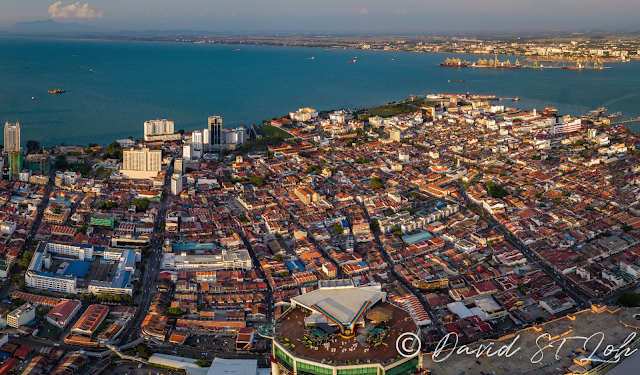
An aerial view of Penang George Town and Butterworth. Image source from https://www.davidstloh.gallery/
Thanks to how the British chose to divide up Southeast Asia, Malaysia has what could be called a unique geography. There are two zones—East and West —separated by 497 miles (800 kilometres) of the South China Sea. West Malaysia is home to the capital Kuala Lumpur, the dynamic island of Penang, and the vast majority of the population. East Malaysia and its two states of Sabah and Sarawak are on the northern third of the island of Borneo, which is shared with the tiny Kingdom of Brunei and Indonesia. This is the jungle, home to abundant natural resources, nearly impenetrable rainforests, and the impressive Mount Kinabalu. It is the Northwest Territories with palm trees. Why, you may ask, did the British divide Malaysia this way?
Ask them. They did the same thing with East and West Pakistan and stuck a big chunk of India in between.
A better question is why Malaysia is just now being discovered as an expat destination. Andy Davison, CEO of Kuala Lumpur–based The Expat Group, which publishes regional magazines, says that timing—when people have worked in Southeast Asia in past years and when extended families have had country exposure—affects their decision to move there later in their lives. “No one worked here in the 70s and 80s,” he said. “Hong Kong and Singapore were the preferred locations for business, banking, shipping, even manufacturing.”
According to Andy, these days there are three basic expat groups that have discovered Malaysia. First, there are the people who like the fact that they can spend extended amounts of time here and take advantage of inexpensive property and the tax benefits (no tax on foreign-sourced income). A lot of Japanese, for example, just come here for extended visits. They don’t tend to live here year round.
The second group relocates here permanently to take advantage of the low taxes, low cost of property, great weather, and the tropical lifestyle. The largest group for which this is the main attraction are the British and Australians.
A smaller third group comes here to get their kids educated in the excellent school system. Koreans and Japanese dominate this group. Often, the father is still working in Seoul or Tokyo and commutes while mum and the kids have a permanent residence here.
The most popular destinations for foreigners living in Malaysia are Penang Island and its main city, Georgetown, and the country’s capital, Kuala Lumpur. About 80 per cent of the total expat population lives in these two centres. Sabah and Sarawak in East Malaysia, due to their remote locations and limited services, have only a few hundred expats.
Although Malaysia is an Islamic country, it is tolerant of other religions and cultures, and the rule of law is firmly rooted in English common law. The constitution of Malaysia allows for a unique dual-justice system—the secular laws (criminal and civil) and Muslim shariah laws. Shariah law applies only to the Islamic community in limited circumstances, and its practice should not put you off the place at all. However, just to add to your peace of mind, there is an island with a progressive government, a robust expat community, a hub for medical tourism, a cost of living that can’t be beat, and the local population has a Chinese and Indian majority.
Penang
Penang Island—off Malaysia’s west coast and connected to the mainland by two long bridges—and its state capital, Georgetown (named after King George II), are like a less crowded, greener Hong Kong, and about one-tenth the size. Georgetown is filled to the brim with the legacies of British colonial times: massive government and High Court buildings stretch out behind imposing Greek columns, and enormous Victorian mansions with manicured grounds dot the waterfront in between the giant new condos and shopping malls.
There is another side of compact Georgetown: the Chinese side. It is the marriage of these two sides that earned the city UNESCO World Heritage Site status in 2008. The combination was described as “architecture unparallelled in Asia.”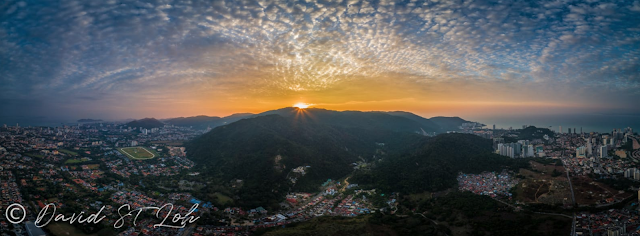
An aerial view of the east coast of Penang island. Image source from https://www.davidstloh.gallery/
In the central core, surrounded by the grand architectural legacy of the British, are the Chinese Malay shop houses, which were working homes with commercial activity of every description on the ground floor and living quarters above. The upper floors have jalousies, wooden louvred upstairs window shutters, that are often painted bright yellow or turquoise blue, giving these old wood structures a tropical, Caribbean feel.
Now protected by UNESCO, the exteriors can be restored but not altered. However, inside you will find galleries, boutique hotels, chic restaurants, and shops. As a cultural and retail experience, old Georgetown is a joy. However, the city’s crushing density tends to lock in the Penang heat and turn off expats from living in the old core. In any case, real estate prices for even a ruin have soared due to the commercial potential. Think of a tropical version of old Montreal forty years ago when it was just beginning to get gentrified and you can see the potential for what old Georgetown is becoming.
UNESCO designated Georgetown a World Heritage Site in 2008, describing the architecture there as “unparalled in Asia.”
Bob
Bob conducted a spreadsheet analysis on the question of where would be the best place in the world to live—that’s the kind of guy he is. When it came time for him to retire at age 60, Bob’s spreadsheet spat out Penang. It ticked all his boxes for what a guy his age needed to live the good life.
Penang, an island off Malaysia’s west coast, which is connected to the mainland by two long bridges, delivered on all Bob’s criteria: they included cost of living, health care, crime, climate, and culture.
We had a drink with Bob and his partner, Marion, on the large terrace of their sub-penthouse apartment. The expansive sea views over the Straits of Malacca, north to the mainland, were breathtaking. The apartment is massive, with five bedrooms, five bathrooms, a sauna, a maid’s room, and a huge entertaining and kitchen area. The complex has a pool and a fully equipped gym. All this costs 6,500 Ringgit, or just $2,100 a month!
“When you sit around and really start thinking about where you are going to go to retire,” Bob said, “it turns out there are a number of criteria that you— everybody really—need to consider. These are taxation, health care, cost of living, crime, climate, and the cultural back story.”
His definition of crime is broad and includes not just crime but the justice system, recourse to law, the legal system itself, the corruption of the police, and “even the likelihood of being robbed or kidnapped walking down the street.”
Like we said, Bob is über-analytical. In any case, according to Bob, that eliminates a lot of South America and Mexico.
Health care is his next criterion. “There are two issues,” he said. “How expensive is it? And how good is it? The United States is expensive. Australia and Singapore are too, but the quality is good. The U.K. is cheap and pretty good. Canada too. Indonesia is just terrible while Thailand and Malaysia are very inexpensive and very good. Here in Southeast Asia, and in particular Malaysia, you don’t have the issues with long waits like [you find in] Western countries. Need anything checked or done? It can happen the same day in immaculate facilities by foreign-trained doctors.”
As for the cost of living, Bob points out the obvious. If you didn’t care about money, you could live anywhere: London, Paris, New York, or the Caribbean. But you will need plenty to live in any of those places. Bob and Marion lived in Switzerland for six months and blew through nearly $90,000 despite having free accommodation with Bob’s brother and the use of a car at no cost. Consider their rent now in Penang and how long it would take to burn through ninety grand!
For Bob that was another box ticked for Penang.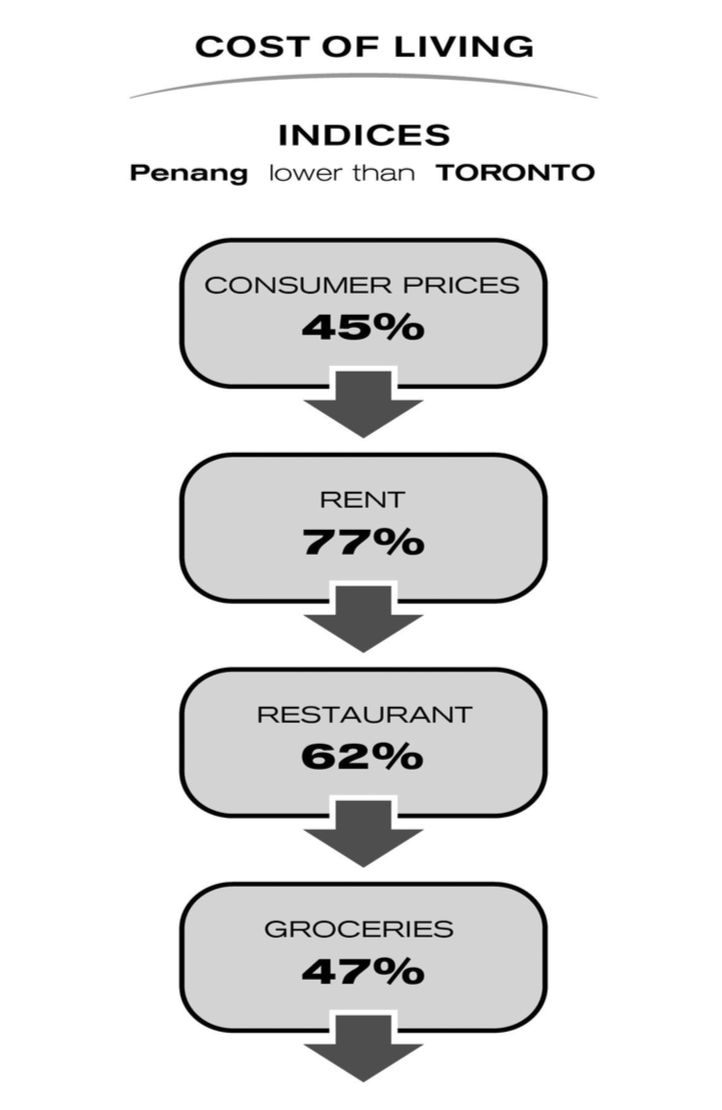
Source: numbeo.com
Language also ranks high on Bob’s decision list. As he says, a dividend of being a former British colony is that English is widely spoken in Malaysia, and even more so in Penang. That gets a big tick. As does Penang’s cultural back story.
“Because you speak English,” Bob explained, “you know a lot about other English-speaking countries, more than you think. I now know a lot about Canada, the United States, England, and New Zealand from the people we have met, and it is such an easy bond to make. What did I know about Switzerland? Who is their president? What are their laws? How does their odd canton voting system work? When you have no cultural back story and you don’t speak the language, it’s too tough to live there. I’m sixty, I want my life to be easy.”
Bob is the sort of guy who does a spreadsheet analysis on where are the best places in the world to live. When it came time to retire, Bob’s spreadsheet spat out Penang.
That, of course, is the bottom line for retiring overseas in Southeast Asia. For instance, do you want it easy or do you want it more adventurous and exotic? We think the joy of Southeast Asia is that you can have one or the other—or just about anything in between—and the price is right. It’s all about what you want.
Judith
Judith moved to Malaysia in 2007. Her arrival happened a lot faster than she expected. This was due to her MM2H (Malaysia My Second Home) visa being a lot easier to get and being approved a lot more quickly than she thought possible.
She is one of those citizens of the world who has lived in many places. Born in the United Kingdom, she left at 21 and lived in South America, South Africa, Australia, and Spain. She never even considered returning to the U.K. as she approached retirement age. “I hate it,” she said. “Can’t stand the place, the people, the weather, their conservative nature. I would rather be in Australia if I could afford it. I think I should have been born there.”
Of her Malaysian decision, she explained, “I had heard about their visa program. I just e-mailed the Malay government and said I fancied becoming a resident and getting an MM2H visa. What do I have to do?”
She said they e-mailed her right back with a list of documents they would need to process a visa: a copy of her passport, details of her income, and proof of medical insurance. These had to be certified by a notary. When she sent them off, she admitted she expected the processing period would take months. To her surprise—her shock—she received her visa in only a few weeks! She had six months to activate her new visa.
“Well, I panicked,” she said, laughing at the memory. “I needed to get over to Malaysia, put money in a bank account, have a medical, and then the visa was instant. It took me less than seven days to make it all happen.”
But then Judith was faced with another problem: where to live.
“It had been years since I had been to Malaysia,” she said. “I didn’t know where to live. I started looking in Kuala Lumpur, downtown, in the suburbs and just talked to people.”
Judith had struck me as a woman of remarkable confidence, but what she said surprised me.
“I’m a country girl at heart,” she said, and admitted that at first “it was daunting, really.” A group of Norwegian friends were living on the top floor of a complex in Times Square, right in the centre of downtown. “But it was so busy.” Not her thing at all. Judith was more down-home prairie than downtown Toronto or Vancouver.
So she gave up on Kuala Lumpur. She rented a car and drove all over Malaysia. She was keen on the island of Langkawi, about 75 miles (120 kilometres) north of Penang. She spoke to residents there and knew it was going to be a solitary and isolated life on a small island. It would take about three hours to get to Penang by boat or a couple of hours by car.
“It is lovely,” Judith said. “It is a tourist island with gorgeous beaches. Here in Penang the beaches are not so good.” Langkawi turned out to be a great place to visit, but she realized that living there would be difficult. If she got sick, she would have to come all the way up to Penang, and that just wasn’t going to work.
Judith finished her search by deciding on Penang, where she has been renting property since 2010. She wisely took her time to settle in. “Once I had my visa, I was in no hurry. I visited often but I sorted myself out first. I find it very busy in Penang, but it is growing on me. I’m not sure if I will spend the rest of my life here—the traffic drives me crazy—but I am liking it more and more because it is just so interesting. There are a huge number of cultures and religions here.”
She added, “I like the people. The food is great. There is lots to do. I joined the International Women’s Association. It’s a great way to meet people as I’m not all that gregarious and it’s not easy for a single person. They have everything from organized card games to film nights to dinners that helped me get and stay engaged.”
Bob, our spreadsheet guy, provided me—not surprisingly—with a detailed perspective of the Penang expat factor.
“You are living on an island of about 700,000 people but it is more like living in a village with a much smaller population. I have done the math two or three different ways, and I get to the same number each time. I work out that there are 2,000 to 3,000 expats on Penang. That community is incredibly well connected.”
It sounds very agreeable. Almost ideal. Bob agreed but then demurred, as if professionally obliged to be objective.
“If there is a downside to it,” he admitted, “it is that all 3,000 expats go to the same shopping malls, the same dry cleaner, the same bars and restaurants.”
But for Bob the numbers don’t lie, and what the numbers tell him is all good. He loves being part of a rich and diverse community of expats. For instance, he said, without too much effort, “by tomorrow night we could have a dinner party with the following demographics: a professional chef (or two), a woman who runs a modelling agency, an orchestra conductor, several professors, some senior military guys, a security expert, a chaplain, even a jockey.” He smiled broadly. “We are swimming in an incredibly rich social pool here, much deeper than we ever had at home.” He gave me a “think about it” look. “And for me, that is the biggest advantage over places like Thailand. Now maybe I’m being a snob—I just don’t think a sex tourist would be as charming a dinner companion, and there are way too many of them in Thailand.”
The majority of expats in Malaysia live, as Bob and Marion do, overlooking the breezy waterfront along Gurney Drive just outside of Georgetown proper and the old town that lies within. Here you find a dozen stylish condos off the promenade and two spanking-new shopping malls. The condo units are enormous in most instances, some up to and over 10,000 square feet (930 square metres)! Four to five thousand square feet (370 to 465 square metres) is common. Even for these vast spaces, rents for a fully furnished 5,000-square- foot unit are hardly ever more than $3,000 a month, and that is for the biggest, highest floor units.
Surprisingly, the cost to buy is not nearly as cheap—this is a very concentrated and preferred area of offshore property for investors and speculators from Singapore and China. When you consider the return on investment on a $3-million apartment renting for just over $2,000 a month, it makes renting look very, very smart. Also in its favour, it is just a few minutes’ walk into old town and all its restaurants, coffee shops, galleries, and stores.
To the north of Gurney Drive is the new development of Quayside. Hundreds of condo units and townhouses are all placed close by the central waterfront mall, which contains a hotel and retail and gourmet shops as well as a marina. Again, it is expensive to buy here (although not as pricey as Gurney Drive) but extraordinarily inexpensive to rent. Condos and apartments are smaller, in the 2,500-square-foot (230-square-metre) range, and go for $2,000 a month, or less. Still further to the north is the community of Batu Ferringhi, the most developed beach area on the island and home to over a dozen hotels catering to every budget. There is a lively night market and many condos and townhouse properties to choose from. Although the beaches here are big and appealing from a distance, on closer viewing the water is far from clean due to years of poorly regulated development, and there is the occasional invasion of jellyfish to contend with. Nothing like a dirty, stinging jellyfish to keep you out of the water.
As for the entire west side of the island, it is pristine. No development, no condos, no malls. It is all protected nature reserve.
Penang, and indeed a lot of Malaysia, is relatively Western compared to Vietnam or Cambodia. Expats call it ‘“Asia light.”
The renewal of old Georgetown is moving at a blistering pace. Two hotel entrepreneurs, Christopher Ong and Karl Steinberg—well known in Asia for their (now-sold) Galle Fort Hotel in Sri Lanka—have developed a number of restaurants and boutique hotels in the old town. They began with Muntri Mews; once an old stable for rickshaws, carriages, and carts, it is now a budget hotel with a small café tucked into a wonderful tropical garden. Next they opened Noordin Mews, an upscale version of their first property, with a pool off the equally lovely garden.
Recently, they returned to their five-star heritage with the Seven Terraces, a luxurious and romantic eighteen-suite boutique hotel created out of seven abandoned shop houses, with a gorgeous restaurant and antique furniture store. Another fantastic property, by Narelle McMurtrie, is ChinaHouse. It is a 400- foot-long, 25-foot-wide (122-metre by 7.5-metre) shop house with an espresso bar, a bakery, a wine store, bistro dining, a formal dining room, and a courtyard burger bar that doubles as a jazz club on weekends. On the second floor is a wonderful gallery, pop-up retail space, and a reading room. We have headed to ChinaHouse in the mid-afternoon for a gallery show, had dinner, and then gone to the jazz bar where we stayed until after midnight. A one-stop entertainment centre.
Property: Renting
A tremendous amount of development is taking place in the key expat areas of Malaysia. In other country chapters, we have strongly suggested renting before you buy to ensure the place is right for you and, in some instances, to avoid complicated issues associated with purchasing.
Malaysia has a unique situation in which rents are impossibly low in relation to purchase prices. Look at Bob and Marion’s deal in Penang. They are renting a massive and luxurious five-bedroom apartment on Gurney Drive overlooking the water for $2,100 a month. To buy that same apartment would be over $2 million. Do the math: the ROI for a property investor is terrible. For the renter, it is fabulous.
Of course, even that monthly rent may be more than a retiree wants to pay, and it certainly may be much more space than they would ever need. Bob and Marion’s place is clearly at the five-star end of the scale. For people of more modest means and needs, the news is even better.
Rent in Kuala Lumpur for a comfortable, furnished two-bedroom, two- bathroom apartment starts from $150 a week. It goes up from there—a luxury apartment downtown with a pool, gym, and parking costs about $1,800 a month.
In Penang, a large three-bedroom furnished apartment, such as Gurney Park, virtually on the water and a walk to old Georgetown, rents for less than $1,000 a month.
And in Ipoh, like Jack and Olga, you can rent a spacious three-bedroom looking up at the Cameron Highlands for $450 a month or buy it for $100,000 or less.
Property: Buying
Non-residents are allowed to purchase residential and commercial property outright in Malaysia, although with some restrictions. The property laws are based on the Australian system whereby the rights of foreigners to own and possess property, and to seek legal redress in the courts, are guaranteed in law.
All purchasers are subject to restrictions on Malay reserved lands and restricted from buying properties allocated for ethnic Malays (known as Bumiputras, they get special considerations over all other races). The minimum investment is $170,000 for foreigners but this amount varies by state. In Penang, for example, the state government has raised the floor price of property for foreign buyers to $340,000 in their efforts to seek a better class of buyer. Landed property has a $700,000 purchase minimum. Below is a description of the four kinds of titles that apply in Malaysia. Although the term “Malay Reserved Land” rarely comes up for expats, it is an added twist. One of the reasons the beautiful island of Langkawi is relatively undeveloped is that much of the better land, beachfront in particular, is reserved for Malays only.
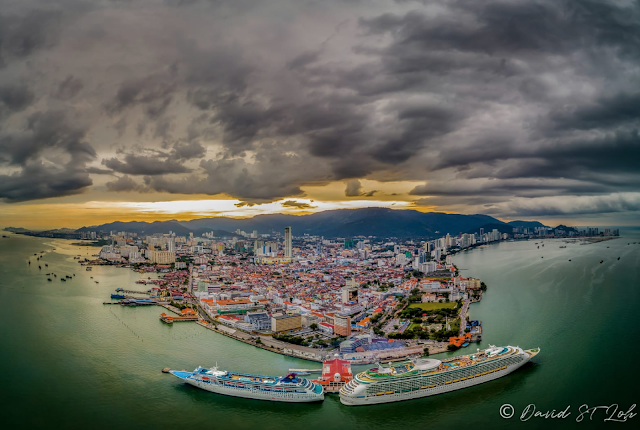
An aerial view of Penang east coast from the Straits of Malacca. Image source from https://www.davidstloh.gallery/
Ownership Titles
Freehold
Freehold property belongs to the owner in perpetuity. Transfer of interest in the property can proceed without any restrictions or approvals from the government.
Leasehold
Land leased by the government for a specific term, most commonly in the duration of 33 years or 99 years. The land will automatically return to the State Authority upon the expiry of the leasehold term. Transfer of interest to another party may require State Authority approval.
Landed
Issued for properties built on individual plots of land that is subdivided horizontally.
Strata
A form of ownership commonly found within residential and commercial multi-storey buildings, as well as landed properties within a gated community. Strata title properties comprise individual lots owned by individual owners and common property, which is defined as everything else on the parcel of land, such as the common stairwell, driveways, roof, etc.
Malay Reserve Land
Article 89 of the Malaysian Constitution states that a person of the Malay ethnicity may own land or possess an interest in a Malay Reservation Area. A Malay Holding includes any alienated land within a Malay Reservation Area that has been duly declared and gazetted as a registered interest of a Malay citizen, a proprietor, or co-proprietor. Once land is gazetted as a Malay Reservation Area, it can only be sold, leased, or otherwise disposed of only to Malay individuals or corporations.
From 2010, the effective capital gains tax rate of selling a property has been set at 5 per cent. No tax is imposed on profits after five or more years of ownership. However, always check for changes in tax laws before you buy. The national bank, Bank Negara Malaysia, does not impose any restrictions on repatriation of profits on property or even proceeds from the divestment of investments in Malaysia. Income earned in the country will be taxed.
Cost of Living
Penang, Kuala Lumpur, Ipoh, and perhaps Johor are all excellent low-cost options for a retiring Canadian.
Grant, a middle-aged early retiree, said, “Here in Penang it is easy Asia. About 99 per cent of the people in Penang speak English, it is inexpensive, laid- back, and relaxed.” While not dirt cheap like the less developed countries of Southeast Asia, it is a lot cheaper than Canada.
Renting a three-bedroom apartment in a very nice waterfront area of Penang or in downtown KL can be 60 to 70 per cent less than a Toronto equivalent. Good internet access is available from four or five providers for $50 a month, unlimited downloads. A cellphone on contract is $18 a month. A landline, free with an internet contract, includes a handset.
A three-course meal in a nice restaurant is 70 per cent less than at home. I can vouch for this myself. Recently, in Penang’s lovely Pulau Tikus market I had fried egg noodles (called mee) with bean sprouts, green onions, chicken, coriander, and chilies for 86 cents. A big cup of strong coffee was 50 cents. Groceries are 30 to 40 per cent less, or even more if you shop the markets and not the Western grocery stores. Grant added, “We shop at what they call the wet market (not really wet, just local) once a week. There is no bargaining, it is a set price—not a foreigner price—we pay the same as the locals do.” Grant reckons fruit and vegetables for the week cost him less than $20 for a family of four. He gets fresh chicken and fish—“and by that I mean a gorgeous plump white- skinned chicken that was alive fifteen minutes ago”—for a fraction of the cost to a Canadian. “We buy chicken breasts to feed our gang of four for less than a dollar each.”
For Grant and his wife, Fiona, the decision to move to Malaysia was as much about lifestyle as it was about an inexpensive cost of living. They found both. Both keen divers, they regularly dive off the coast of Langkawi but also drive to the Perhentian Islands off the east coast, a six-hour drive from Penang. “It is the most glorious place. The water is a transparent blue, and the island’s accommodations are so incredibly cheap. We rent a shack right on the beach, put hammocks up between the palm trees, and just relax,” Fiona said.
Not everything is inexpensive. Although a water bill is just $2 a month, electricity costs can be high because air conditioning giant condo spaces in a tropical climate can be costly. Expect a monthly bill of $250 or higher if your space is in the 4,000- to 5,000-square-foot (370- to 465-square-metre) range. Cars are heavily taxed, especially imported cars. Locally produced vehicles such as Protons and Peroduas are cheap as chips but tend to have the build quality of the Ladas we used to buy in Canada in the 70s. But of course, no rust problems here. Expect to pay $20,000 for a locally produced seven-passenger people mover.

Source: numbeo.com
Medical Services
One of the great attractions of Malaysia for a retiree is the country’s excellent medical services and facilities. Like Thailand, Malaysia is a prime destination for medical tourism. There are seventy flights a week from Indonesia to Penang alone, made up of Indonesians seeking quality medical care. The Prince Court Medical Centre in Kuala Lumpur is ranked number one in the world for medical tourism—better than Bangkok, better than Singapore, better than North America, and better than Europe.
In Penang, we met up with Kendall and her family, and they have no medical insurance.
“We cancelled it,” she said.
That seemed very risky. She explained her decision.
“Most expats don’t worry much about insurance unless the company they work for pays for it. The medical care here is very good, with nearly 100 per cent of medical staff internationally qualified. The dentists too are excellent and cheap. You can walk right in to a GP, no appointment required. For us, an appointment, consultation, and antibiotics cost $25. Pharmacists here sell everything you need over the counter.” There are nine hospitals on the island of Penang, she said, at least half of which service the international medical tourism business. “I have heard no horror stories here about quality of care. Just simply excellent.”
Kendall is under 55, and having medical insurance isn’t an issue for her ... yet. But Ellen, who lives in Kuala Lumpur, is 67 and she doesn’t have it either. To the average risk-averse Canadian—like me—that decision seemed beyond risky. Ellen explained that people over 65 have a hard time getting insurance coverage if they didn’t sign up when they were younger. But, according to her, the standard of services in KL is so good and the costs so reasonable that she is not worried.
One of the great attractions of Malaysia for those over 55 years of age is the country’s excellent medical services and facilities. They are on par with Thailand and compete with the Thais’ for medical tourism.
Medical treatments that may cost hundreds of thousands of dollars in Singapore or Sydney without health coverage, she points out, would cost only a few tens of thousands in Malaysia. “I take that into account. I know that I need to set aside enough money to cover a big medical bill if I got really ill.”
We admit that such an approach—such an attitude—may be difficult to accept. Frankly, we have a hard time with it. But what you know is what you are used to, right? Just because we proudly live in Canada and tout our universal health care to the Americans doesn’t mean our health care system functions as well as the better Asian ones.
Despite high-quality and inexpensive care, as we have suggested for other low-cost countries, if you can possibly get medical insurance, get it. If you are a part-time resident keeping your Canadian coverage, supplement it with a reasonable travel insurance policy that provides medical evacuation. At least check your province’s services because what they provide offshore can vary.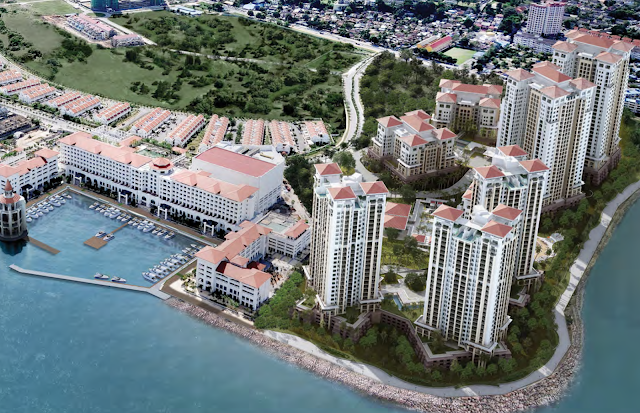
18 East, Andaman at Quayside - designed with a private waterpark (first of-its-kind in the region), complete clubhouse, lush greenery, open spaces to enjoy sea breeze, communal spaces & facilities. A private resort with luxurious living space. Next to Straits Quay, Penang’s first seafront retail marina >>more
Visas and Immigration
Malaysia is the most retiree-friendly country in Southeast Asia. The MM2H (Malaysia My Second Home) program offers foreigners a renewable, ten-year, multiple-entry visa. It gives certainty of tenure, it’s a streamlined application process, and it’s tax friendly. All non-Malaysian–sourced income, including pensions, is tax-free to MM2H visa holders.
Different requirements are in place for applicants under 50 years of age and for those over 50. If you’re under 50, you will need proof of liquid assets of $170,000 and a demonstrated monthly income of $3,400.
For applicants over 50, the requirement drops to proof of assets of $118,000, a fixed deposit of $50,000, and the same level of monthly income as for under- 50s. The fixed deposit earns interest and that interest is tax-free.
That fixed deposit can be reduced if you buy property in Malaysia, if you have medical expenses that are deductible, or if you deduct payments for children’s education, which you are allowed to do. Although you are required to have medical insurance, the authorities will immediately waive that if you are turned down on the basis of age. A clean home-country police report and an in- country medical checkup are also required. Once your visa is granted, you have six months to activate it. The visa allows you to bring in parents over age 60 on a one-year renewable visa and covers your children up to age 21 as dependants.
The MM2H visa is unique in the world as it is the only visa designed to attract retirees with a list of benefits that no other country, Western or Asian, currently provides.
This is a very good deal. However, in the event you don’t have that kind of money to invest, a normal tourist visa for entering Malaysia is good for ninety days (not three months, ninety days) and can be renewed every time you leave the country. Unlike other countries (such as Singapore), a simple standard visa allows you to rent a condo, get a cellphone, sign up for utilities, etc. You do need the visa to get a Malaysian driver’s licence or to purchase a car.
Tips and Traps
Final Thought
Malaysia has been a bit of an enigma as it fell off, or really never made, the expat radar for decades. Now, it is a premier choice for expat retirees as an affordable, friendly, safe, and sophisticated destination. It is not scrubbed and sanitised like Singapore, nor is it sexy–crazy like parts of Thailand. It has some edge and a little third world to it, but it is first world all the way in all the things that matter to a Canadian retiree.
The Checklist
Whether you are buying, selling, or just plain interested in real estate, connect with Penang Property Angel today for professional assistance.
Copyright 2026 Disclaimer: Pictures, descriptions, contents and materials in this advertisement are the sole property of PG PROPERTY ANGEL. In the event any party copies, reproduces or uses any of the contents in any manner whatsoever without the express consent of both PG PROPERTY ANGEL and its clientele, PG PROPERTY ANGEL reserves the right to institute legal proceedings against the said party for all legal remedies available to PG Property Angel.
powered by
